

Two Six Technologies Named Top 10 Finalist in NATO Innovation Challenge for Agentic AI in Cognitive Warfare
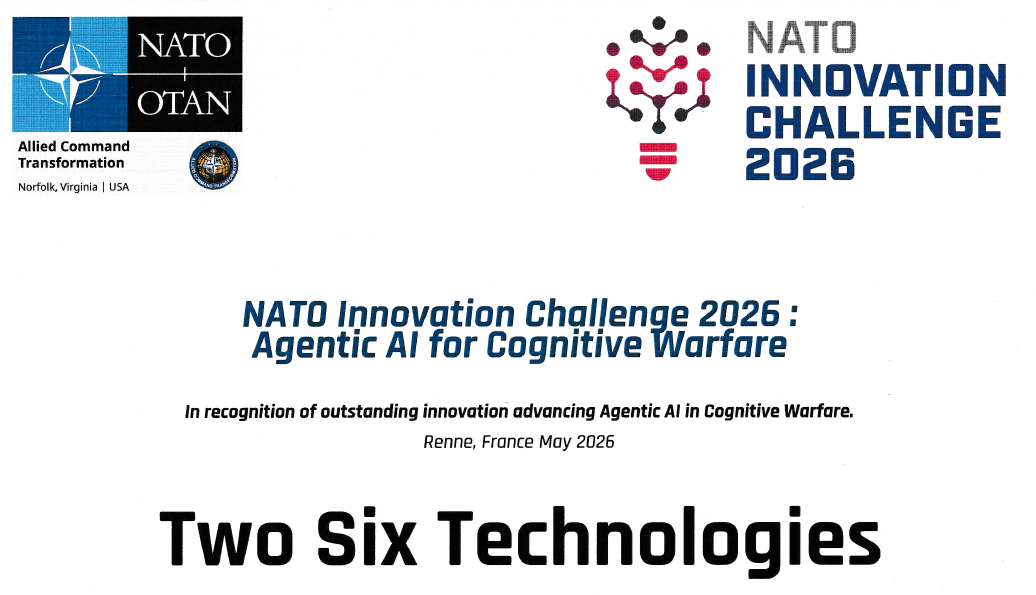
Two Six Technologies has been selected as one of ten finalists in the NATO Allied Command Transformation (ACT) and NATO Supreme Headquarters Allied Powers Europe (SHAPE) Innovation Challenge focused on Agentic AI for Cognitive Warfare, placing the company among a select group of organizations helping shape the future of information operations across the NATO Alliance.
The challenge attracted more than 100 companies from NATO member nations, all competing to provide innovative technologies that can help NATO counter adversarial influence campaigns, psychological manipulation, and efforts to disrupt military decision-making processes. The initiative marks NATO’s 18th Innovation Challenge and reflects growing concern over threats targeting the cognitive domain, where adversaries seek to influence perceptions, shape public opinion, and undermine trust through coordinated information operations.
Two Six Technologies earned recognition for its cognitive advantage platform which leverages custom-tailored agentic AI to accelerate the planning, execution, and assessment of cognitive warfare operations. The platform is designed to enhance the effectiveness of information operations teams operating in increasingly complex and rapidly evolving information environments.
NATO’s selection validates our mission-focused approach to developing technology that helps governments and organizations understand, navigate, and compete in today’s information environment. As foreign malign influence campaigns continue to grow in sophistication and scale, solutions that combine human expertise with advanced AI capabilities are becoming increasingly critical.
The NATO challenge seeks dual-use agentic AI solutions capable of supporting strategic communications and information operations across five key stages: situational understanding, planning, coordination, delivery, and assessment. Desired capabilities include analyzing complex information environments, detecting shifts in public sentiment, mapping influence networks, and generating communication strategies that can adapt in real time.
Importantly, NATO has emphasized that selected solutions must maintain meaningful human oversight. The alliance is seeking what it describes as “human-led judgment plus AI-enabled scale and synthesis,” rather than fully autonomous influence operations. Proposed technologies must also adhere to NATO’s Principles of Responsible Use for Artificial Intelligence, including requirements for lawfulness, explainability, reliability, and bias mitigation.
Two Six Technologies’ selection as a finalist highlights its potential to support NATO’s efforts to achieve information advantage while ensuring responsible and transparent use of AI. The platform’s agentic AI capabilities are designed to help operators better understand narrative landscapes, identify emerging influence threats, and evaluate the effectiveness of information operations campaigns.
The competition culminates with a finalist pitch event in Rennes, France, where selected companies will present their solutions to NATO leadership and defense stakeholders. Finalists were chosen based on their ability to address NATO’s evolving cognitive warfare requirements and provide practical tools for countering adversarial influence operations.
For Two Six Technologies, the recognition underscores the growing international relevance of its cognitive advantage capabilities and reinforces the company’s commitment to supporting NATO and allied partners in confronting emerging challenges in the information environment.
As competition increasingly extends into the cognitive domain, where narratives and perceptions can shape strategic outcomes, NATO’s investment in agentic AI technologies signals the alliance’s determination to maintain information superiority and protect decision-making processes against foreign malign influence.