
More Sophistication, Less Slop: Russian and Chinese malign influence actors are working smarter in the age of AI
AI is changing foreign malign influence tactics—but not in the way you might expect. Rather than flooding the information environment with easily generated content, Russia and China are adapting with accounts that behave more like humans. They are also using AI to enrich their posts with visual content and to reach new audiences with translated material. Influence operations are evolving to stand out in an internet full of AI slop and to avoid being called out by social media platforms’ AI-enabled bot detection.
Our team developed a new methodology to train machine learning models to identify unattributed malign influence accounts (also called inauthentic accounts) on X with high confidence (see methodology note below). We applied this methodology to analyze data from pro-Russia and pro-China accounts in 2024, 2025, and 2026. This work enabled us to draw statistically rigorous conclusions across actors and over time. Please contact us to request a full copy of our Biannual Manipulation Report, which discusses the below findings in more detail.
Russian and Chinese inauthentic accounts are probably using AI to enhance content quality rather than to increase content volume.
Malign actors are not using AI to increase post volume and are probably not using it to generate new accounts, even though the technology keeps making it easier to create material.
- Fewer posts: malign accounts cut their post volumes in half during 2024–2026 (see Figure 1).
- No increase in post length: We saw no significant change in the length of original posts for Russia or China.
- No major increase in the number of accounts: The number of inauthentic accounts active on X fluctuated but remained on the scale of thousands (ranging from 5,000 to 11,000 each for China and Russia) across all three years. Malign actors are not widely adopting AI agents to create new accounts, possibly because they lack the skills to deploy AI agents for this purpose or because the X platform is sufficiently protected against AI agents. Instead of creating new accounts, malign actors are repurposing old accounts for new campaigns (see Figure 2).
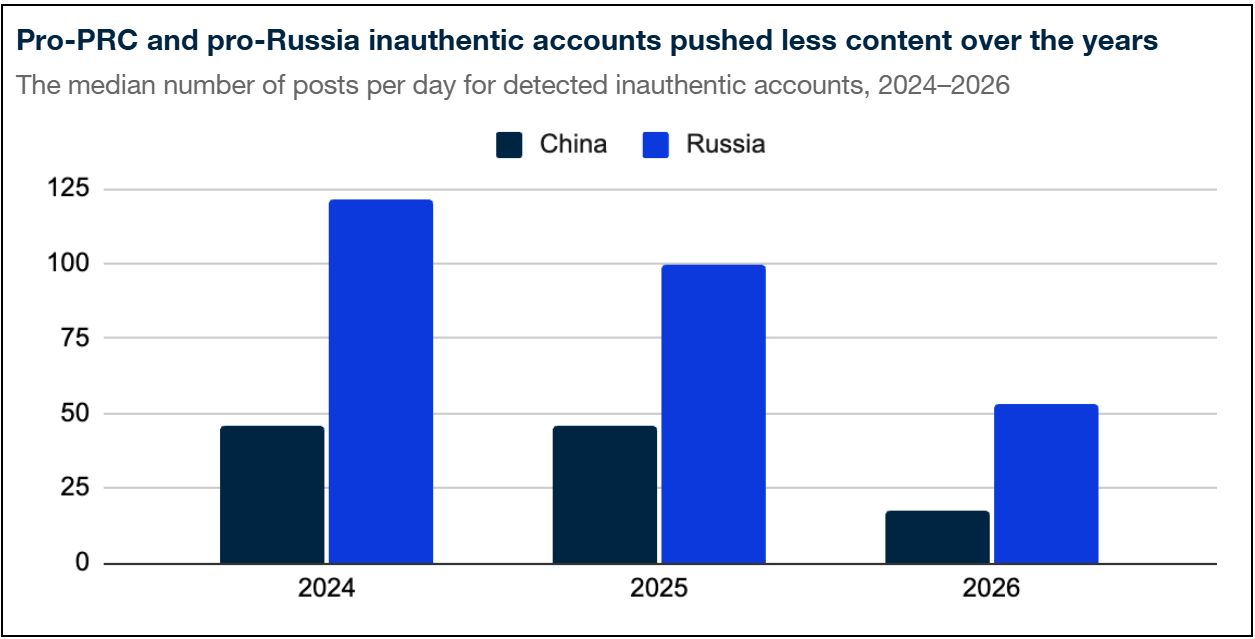
Figure 1
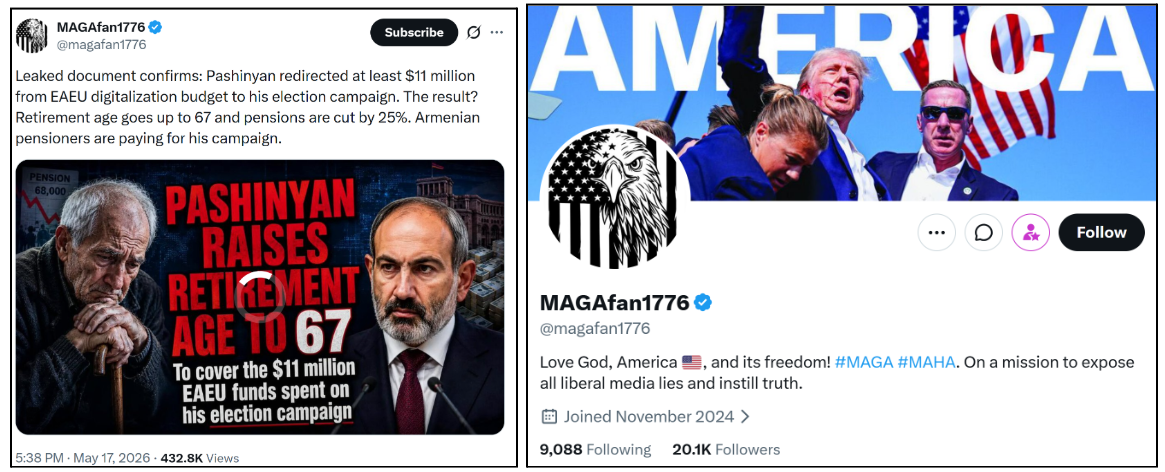
Figure 2: A video shared as part of a pro-Kremlin inauthentic campaign to smear Armenian prime minister Nikol Pashinyan during Armenian elections (left) was shared by an account (profile image on the right) created in 2024 that identifies itself with the US.
AI is enabling and motivating adversaries to craft better content and more human-like accounts. Inauthentic accounts are using AI to add visual appeal to their content. To reach broader audiences, they are probably also using it for translation.
- More images: The share of original posts with images more than quadrupled for pro-Russia accounts and doubled for pro-China accounts. Some of these images are AI generated (see Figure 3).
- More languages: Accounts are probably using AI for translation, allowing for linguistic expansion. Pro-Russia accounts are now using a median of six different languages, compared to just two in 2024. Pro-China accounts are increasingly using more English and less Chinese.
- Fewer bot-like behaviors: Pro-Russia and pro-China accounts now have slower posting speeds, and more pro-Russia accounts are inactive for a long stretch each day, mimicking a human who sleeps.
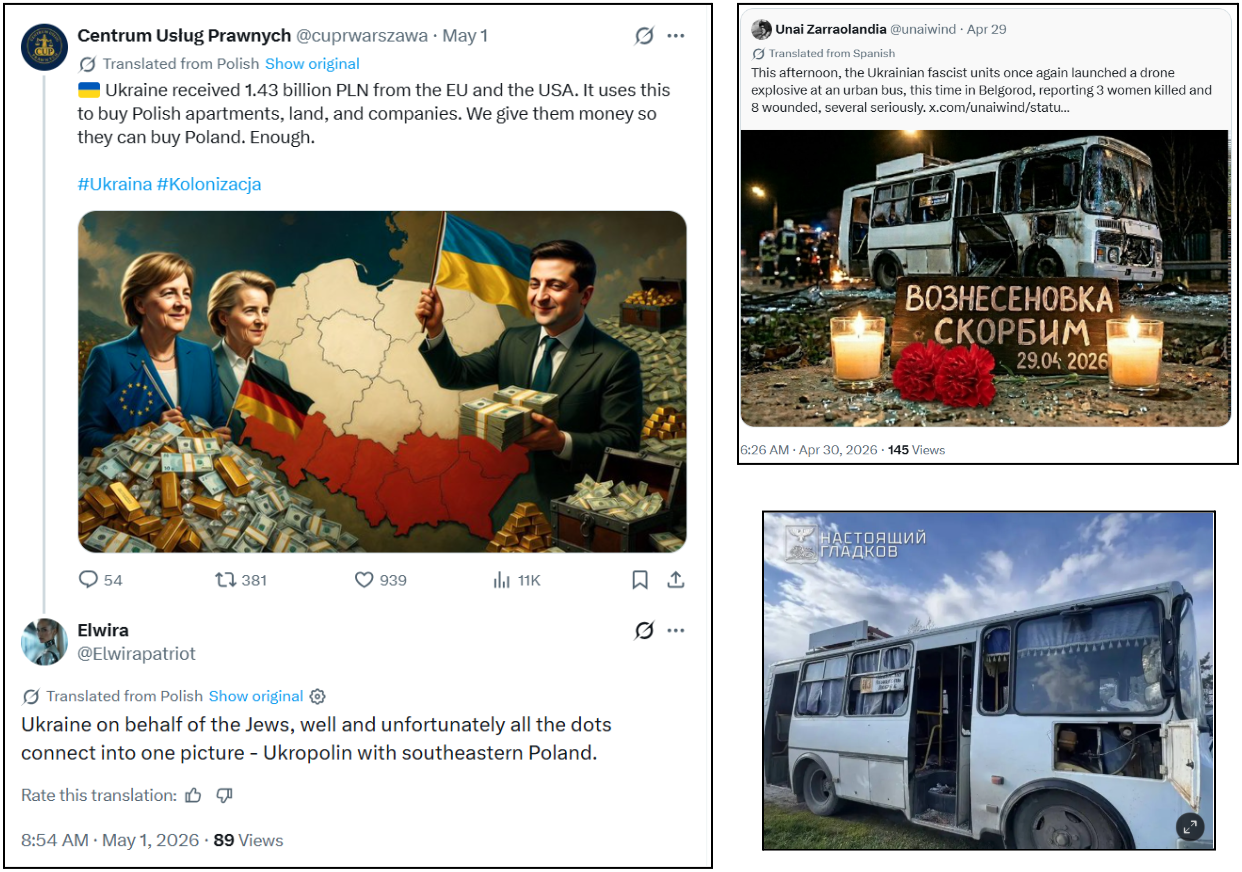
Figure 3: Some images are easily identifiable as AI generated. On the left, a pro-Russia inauthentic account commented on a post with a clearly AI-generated cartoon disparaging Ukraine. Other uses of AI are less obvious. The image on the top right, shared by a pro-Russia, inauthentic account to blame Ukraine for an attack on a civilian bus, looks plausible at first glance. However, it is fake; the real bus that the strike hit (bottom right) was much less damaged.
Most Russian and Chinese inauthentic accounts get no traction. A few pro-Russia accounts are exceptions.
Is this quality over quantity strategy working? For the most part, no. Among posts from both Russia and China across all three years, the typical account received just one engagement per every 3-50 posts.
However, every year, we found an average of 15 pro-Russia inauthentic accounts that had tens of thousands of followers. These accounts do get traction; many of the likes and shares they get are real. Some likes and shares, however, are from other inauthentic accounts, because this group of outlier accounts creates much of the original content that fuels the rest of the inauthentic network.
- Accounts in this group of outliers garnered an average of 17–22 engagements per post.
- In 2026, 72% of posts from the outliers contained original content, compared to just 10% of posts from the full group of inauthentic accounts.
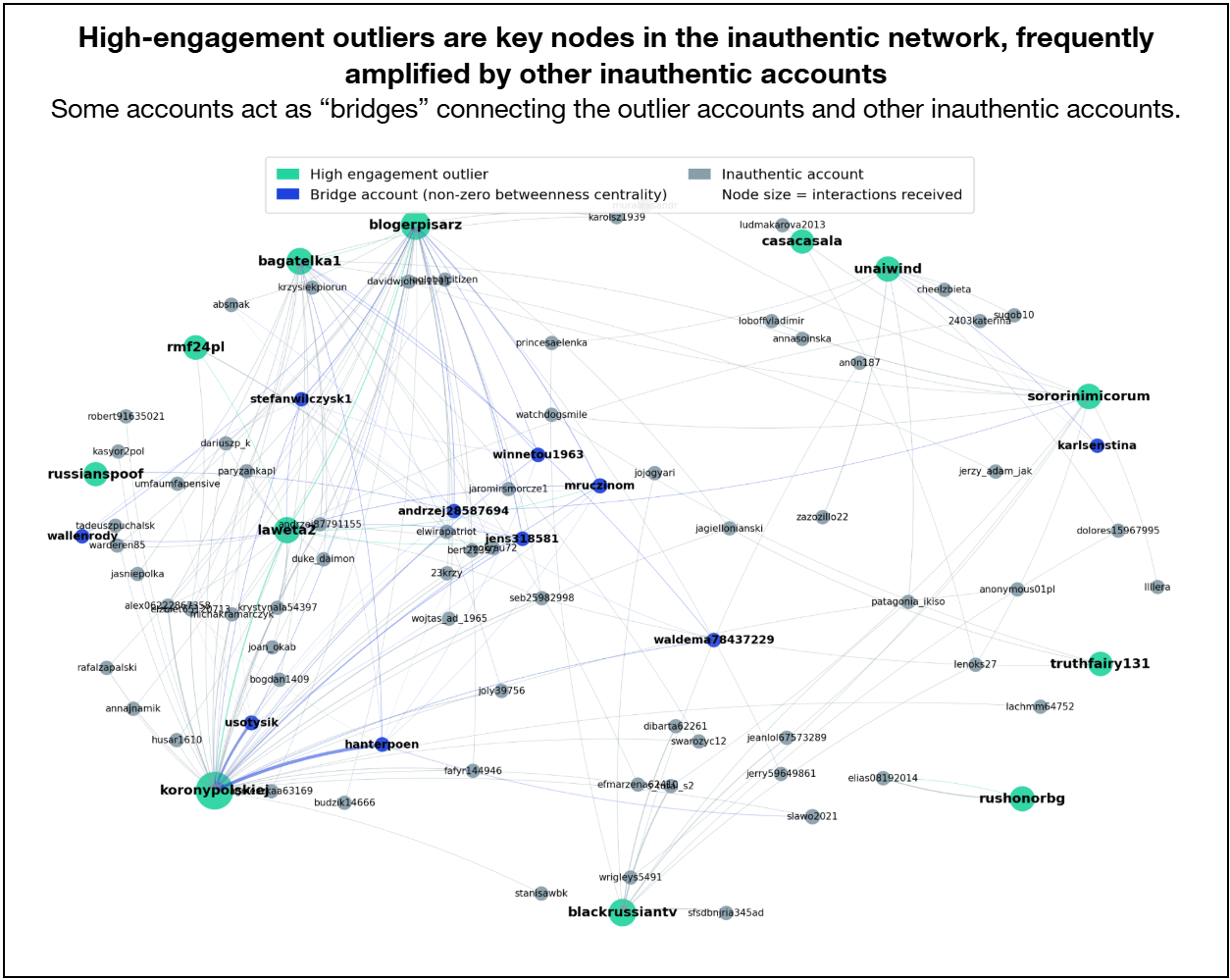
Figure 4: A network plot of the inauthentic accounts for 2026. Other years showed similar patterns.
The US faces a barrage of criticism from Russian and Chinese accounts—a major pivot from prior, pro-Trump Russian narratives.
Pro-Russia actors attacked the US and President Trump more than it criticized the US under President Biden—a dramatic reversal from prior, pro-Trump messaging. The shift in narratives likely took place because of Moscow’s dashed hopes that President Trump might strong-arm Ukraine into ending the war on terms favorable to Moscow. Using an LLM-enabled methodology to analyze thousands of posts, we found the following anti-US narratives peaked in 2026 compared to 2024 and 2025:
- Ad hominem attacks against the president and other US individuals: up 264% compared to 2024
- Meanwhile, positive messaging about the US or any US person, especially President Trump, dropped 82% between 2025 and 2026.
- Narratives about US military weakness and decline: up 263%
- Anti-US conspiracy theories and claims of US crimes against humanity: up 124%
- Narratives about US military interventionism and warmongering: up 66%
- Narratives about US imperialism: up 65%
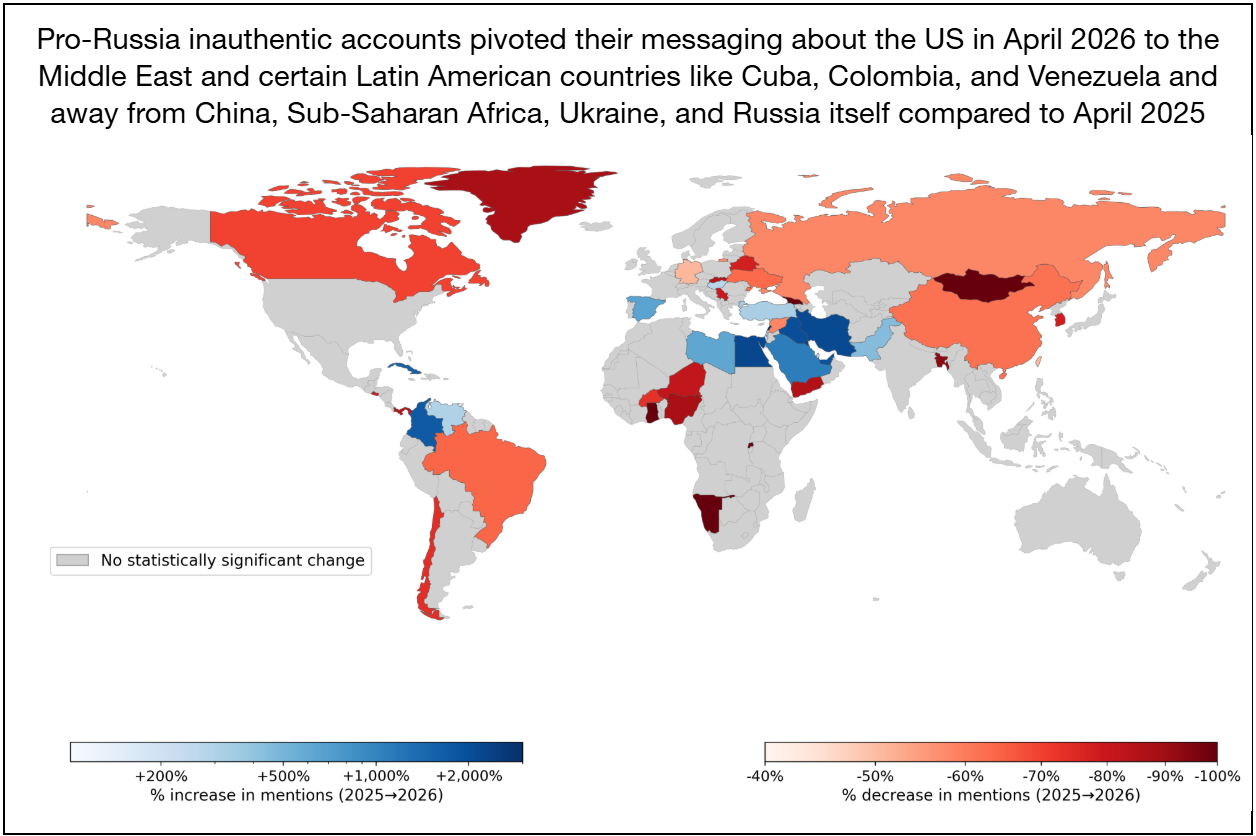
Figure 5
Pro-China actors have consistently pushed anti-US narratives, depicting Washington as a military and economic destabilizer across all three years.
- Inauthentic accounts started emphasizing China’s AI strength compared to the US’s in 2025, making China’s dominance in the AI race one of the top overarching narratives detected in both 2025 and 2026.
- Japan became a focus of inauthentic accounts’ discussions of the US in 2026. Accounts portrayed Japanese Prime Minister Sanae Takaichi as a US puppet.
Methodology note
Definition: We define unattributed foreign malign influence accounts—which we call “inauthentic” accounts throughout the report—as accounts that meet all three of the below behaviors and characteristics:
- They share pro-China or pro-Russia content.
- They are unattributed, meaning they are not, and do not claim to be, overtly affiliated with the Chinese or Russian governments.
- They are malign actors. By malign actors we mean they are one or both of the following:
- They are bots (they have automated posting behavior).
- They misrepresent themselves; that is, they appear to be operated by a user other than the one that they present themselves to be. A user that transparently states that it promotes pro-China or pro-Russia content, absent indicators of automation, would not be classified as malign.
Scope: The methodology identifies inauthentic accounts that at least sometimes share explicitly pro-China or pro-Russia (or anti-Ukraine) content and that persist over time. Out of scope are deep cover accounts that post only about another country’s politics without reference to China or Russia (or Ukraine). We also do not include burner accounts intended to share only one narrative. Scoping our analysis to one platform, X, allowed us to focus on change over time rather than cross-platform variables.
Attribution: We do not attribute the operation of the campaigns directly to the Chinese or Russian governments. The campaigns may be carried out by a variety of pro-China or pro-Russia actors, with or without direct orders from their governments. In fact, we intentionally captured a broad spectrum of inauthentic accounts, not limited to any particular known or attributed network, to ensure that our findings were not driven by the idiosyncrasies of any particular actor or network.
Identification process: We combined human expertise and unsupervised and supervised machine learning models to identify inauthentic accounts with high confidence. Across our models the average precision was 86% and the average recall was 83%. For more detail on our methodology, please request a copy of our full Biannual Manipulation report.